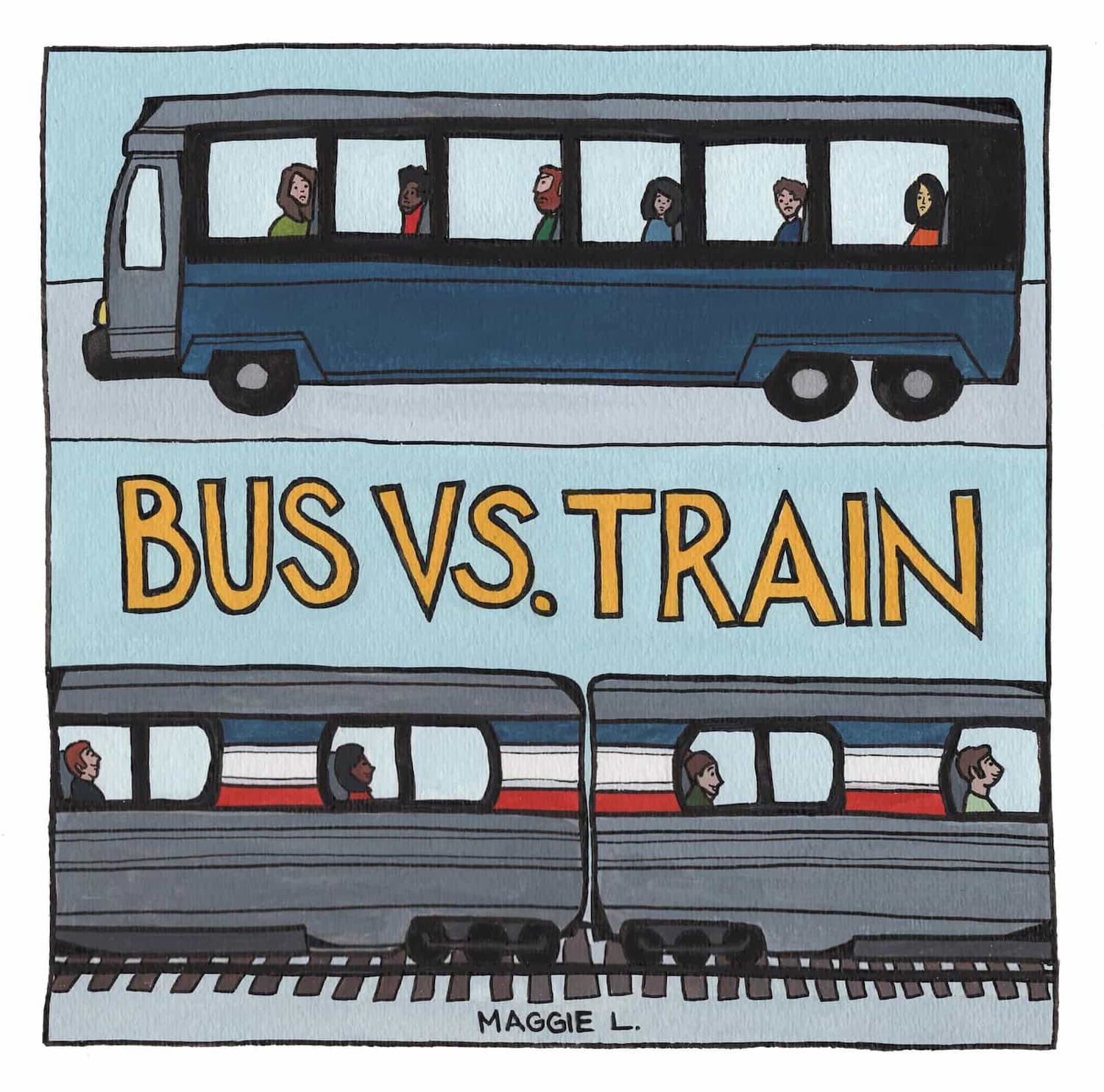
For students in the USA, travel is often a mix of excitement and stress. You want to get from campus to home, from one state to another, or just out for a short break without emptying your bank account. Flights are fast but pricey. Cars cost fuel, insurance, and parking. That leaves two classic budget options on the table: bus travel and train travel.
At first glance, both look cheap. Both cover huge distances. Both promise a seat and a way to move without driving. But once you start comparing real costs, comfort, time, and flexibility, the differences become clear fast.
If you are choosing between a bus and a train for your next trip as a student, this full breakdown will help you pick what actually fits your budget and lifestyle.
Many students also use this exact topic for academic work because it is a perfect real life comparison.
Right after reading this kind of breakdown, a lot of learners choose to buy comparison essay to turn real travel data into a clean academic essay that meets all formatting and analysis rules.
Now let us break it all down the practical way.
Ticket Prices and Real Student Costs
When students ask which option is cheaper, the answer in most cases is simple. Bus travel usually wins on pure ticket price.
Average Bus Ticket Costs
Bus companies regularly offer:
- One way trips between cities for 15 to 40 dollars
- Discount passes for students
- Last minute deals if seats remain open
For example, traveling from one major city to another several hours away by bus often stays under 30 dollars if booked early. Even long distance routes can stay under 80 dollars.
Average Train Ticket Costs
Train tickets usually cost:
- 30 to 70 dollars for short to medium routes
- 100 dollars or more for longer journeys
- Higher prices during peak seasons
Train prices move up quickly because there are fewer seats and higher operating costs.
Verdict on Price
If your main goal is to spend as little as possible, the bus usually comes out cheaper. Train travel can compete only on certain routes or with early booking.
Hidden Fees and Extra Charges
Many students only look at base prices and forget about hidden costs.
Bus Travel Fees
Bus travel often adds:
- Small booking fees
- Charges for extra luggage
- Seat selection fees on some routes
Still, even with these add on costs, buses stay within low budget range.
Train Travel Fees
Train travel may include:
- Seat upgrade charges
- Baggage fees on certain routes
- Reservation change fees
These extra charges can push total cost well above what many students expect.
Comfort on Long Distance Trips
Budget is important, but comfort matters when you are stuck on a seat for six or ten hours.
Comfort on Buses
Bus comfort depends heavily on the company. In general, students get:
- Narrower seats
- Limited leg room
- Basic restroom access
- Minimal sound insulation
Some newer buses offer WiFi and power outlets. Some do not. Long rides can feel tiring, especially overnight.
Comfort on Trains
Trains usually offer:
- Larger seats
- More leg room
- Wider aisles
- Easier restroom access
- Smoother ride overall
Students can stand up, stretch, move between cars on long routes, and feel far less cramped.
Verdict on Comfort
For trips longer than four or five hours, train travel is clearly more comfortable for most students.
Travel Time and Speed

Students often juggle classes, work shifts, and deadlines. Time matters.
Bus Travel Time
Bus routes:
- Are affected by city traffic
- Can face long delays
- Often take indirect highways
- Make many stops
Even if the schedule says six hours, delays can push that to seven or eight easily.
Train Travel Time
Train routes:
- Avoid road traffic
- Run on fixed rail lines
- Usually keep to schedule more closely
- Offer more predictable arrival times
Trains are not always faster in theory, but they are often more reliable in real conditions.
Verdict on Time
If your schedule is tight and you must arrive on time, trains are more dependable.
Safety and Security for Students
Safety matters a lot, especially for solo travelers.
Safety on Buses
Bus stations:
- Are often located in busy city areas
- Can feel unsafe late at night
- May have limited staff presence
On board:
- Security checks are minimal
- Passenger screening is light
This does not mean buses are dangerous, but students must stay alert with luggage and personal items.
Safety on Trains
Train stations:
- Usually have more staff
- Have better lighting and patrols
- Offer more structured boarding
On board:
- Conductors walk through cars
- Staff presence is more visible
Verdict on Safety
Most students feel safer on trains, especially during evening and overnight travel.
Luggage Rules and Flexibility
Students often carry more than one bag, especially during semester breaks.
Bus Luggage Rules
Bus companies usually allow:
- One or two free checked bags
- Limited carry on space
- Extra fees for oversized luggage
Heavy suitcases sometimes become an issue.
Train Luggage Rules
Train systems usually allow:
- Multiple carry on items
- Larger checked baggage
- Fewer restrictions overall
Students with instruments, sports gear, or large suitcases often find trains more flexible.
Accessibility for College Campuses
Not every campus connects the same way.
Bus Accessibility
Bus routes:
- Stop at more small towns
- Reach campuses that trains skip
- Offer greater route flexibility
Students at rural colleges often rely on buses because train stations may be far away.
Train Accessibility
Train stations:
- Focus on large cities
- Require extra transfers for many campuses
- Often need local transport after arrival
Urban based universities benefit more from train access.
Environmental Impact for Budget Conscious Students
Many students now care about carbon footprint as well as price.
Bus Environmental Impact
Buses:
- Carry many passengers per vehicle
- Produce moderate emissions
- Are more eco friendly than individual cars
Train Environmental Impact
Trains:
- Carry large passenger volumes
- Use electricity on many routes
- Produce lower emissions per passenger
Verdict on Sustainability
From an environmental view, train travel is usually the greener option.
WiFi and Power Access for Study on the Road
Many students travel while working on assignments.
Bus Connectivity
Some interstate buses offer:
- Basic WiFi
- Shared charging ports
- Unstable connections
Remote study on buses can be unreliable.
Train Connectivity
Trains more often provide:
- Stronger WiFi
- Dedicated power outlets
- Better table space on many cars
For students working on laptops, trains offer a more stable study setup.
Food Access and Breaks
Long travel needs food planning.
Bus Food Access
Bus travel:
- Includes quick roadside stops
- Offers limited station food options
- Requires planning your own snacks
Train Food Access
Train travel:
- Often includes cafe cars
- Allows longer station stops
- Makes it easier to grab meals
Food on trains costs more but is easier to access.
Reliability During Peak Travel Seasons
Holidays and summer breaks bring crowds.
Bus Reliability
During peak periods:
- Bus seats sell out fast
- Delays become common
- Overbooking issues sometimes appear
Train Reliability
Trains also fill up quickly, but:
- Capacity control is stricter
- Boarding is more structured
- Cancellations are less common
Bus vs Train for Different Student Travel Scenarios

Short Distance Travel Under Three Hours
Bus usually makes more sense due to lower price and minimal comfort difference.
Medium Distance Travel Between Four and Eight Hours
Train becomes more attractive because comfort and time reliability start to matter.
Long Distance or Overnight Travel
Train is generally the better choice for sleep, safety, and reduced fatigue on arrival.
Budget Breakdown Example
Let us compare a typical student trip between two major cities around five to six hours apart.
Bus:
- Ticket around 28 dollars
- One checked bag included
- Possible delay due to traffic
- Limited comfort
Train:
- Ticket around 55 dollars
- More luggage flexibility
- Stable arrival time
- Higher comfort
In pure financial terms, the bus saves about 27 dollars. In comfort and time reliability, the train wins clearly.
Bus vs Train Travel in US
| Factor | Bus Travel | Train Travel |
| Average Ticket Price | Lower cost, often 15 to 40 USD | Higher cost, often 30 to 100 USD |
| Hidden Fees | Small luggage and booking fees | Seat upgrades and change fees |
| Comfort Level | Narrow seats, limited leg room | Wide seats, more space to move |
| Leg Room | Limited | Generous |
| Ride Smoothness | Affected by traffic and roads | Smooth and stable |
| Travel Time Reliability | Prone to delays from traffic | More predictable arrival times |
| Safety at Stations | Varies by city, less supervision | Better lighting and staff presence |
| Onboard Security | Minimal checks | Regular staff presence |
| Luggage Flexibility | One to two bags, size limits | More bags, fewer limits |
| Campus Accessibility | Better for small towns and rural campuses | Best for large city campuses |
| WiFi and Power Access | Inconsistent | More stable and reliable |
| Food Access | Limited roadside stops | Cafe cars and longer station stops |
| Environmental Impact | Moderate emissions | Lower emissions per passenger |
| Best For | Short trips and tight budgets | Long trips and comfort focused travel |
Which Option Is Better for Students on a Budget
The answer depends on what you define as budget priority.
If your goal is the lowest possible cash spend, the bus is your winner.
If your budget includes:
- Less physical stress
- Better safety
- More reliable arrival
- Ability to study while moving
Then the train often becomes the wiser long term choice even with a higher ticket.
Some students use a mixed approach: buses for short cheap trips, trains for longer demanding travel.
Why This Topic Works So Well for Comparison Essays
Bus vs train travel is one of the strongest real world comparison essay topics because it offers:
- Clear measurable variables
- Real financial data
- Comfort and safety factors
- Time and environmental angles
- Social and accessibility issues
Students can compare:
- Cost efficiency
- Social experience
- Economic access
- Environmental effects
- Infrastructure differences
This allows deep academic comparison with real life relevance.
Common Student Mistakes When Comparing Bus and Train Travel
- Looking only at ticket price
- Ignoring time loss and fatigue
- Forgetting safety differences
- Skipping environmental factors
- Using outdated travel data
A strong comparison essay always balances money, experience, and reliability.
Sooooo, What is the Verdict?
There is no single perfect answer for every student. Bus travel remains the cheapest option and works well for short trips and tight budgets. Train travel costs more but gives better comfort, higher safety, and greater reliability. Your decision should depend on your schedule, stress tolerance, finances, and purpose of travel.
For many students, the smartest strategy is simple. Use buses when cost outweighs comfort. Use trains when time, safety, and rest matter more.
Final Thoughts
Choosing between bus and train travel in the USA is not just about money. It is about how you handle long rides, how much time you can spare, and how much stress you can tolerate for lower cost. Both options serve students well in different situations.
As a real life topic, this comparison also works perfectly for academic writing, social science analysis, and economic evaluation tasks.
When students handle the data properly and balance all factors, this type of essay often scores very well.